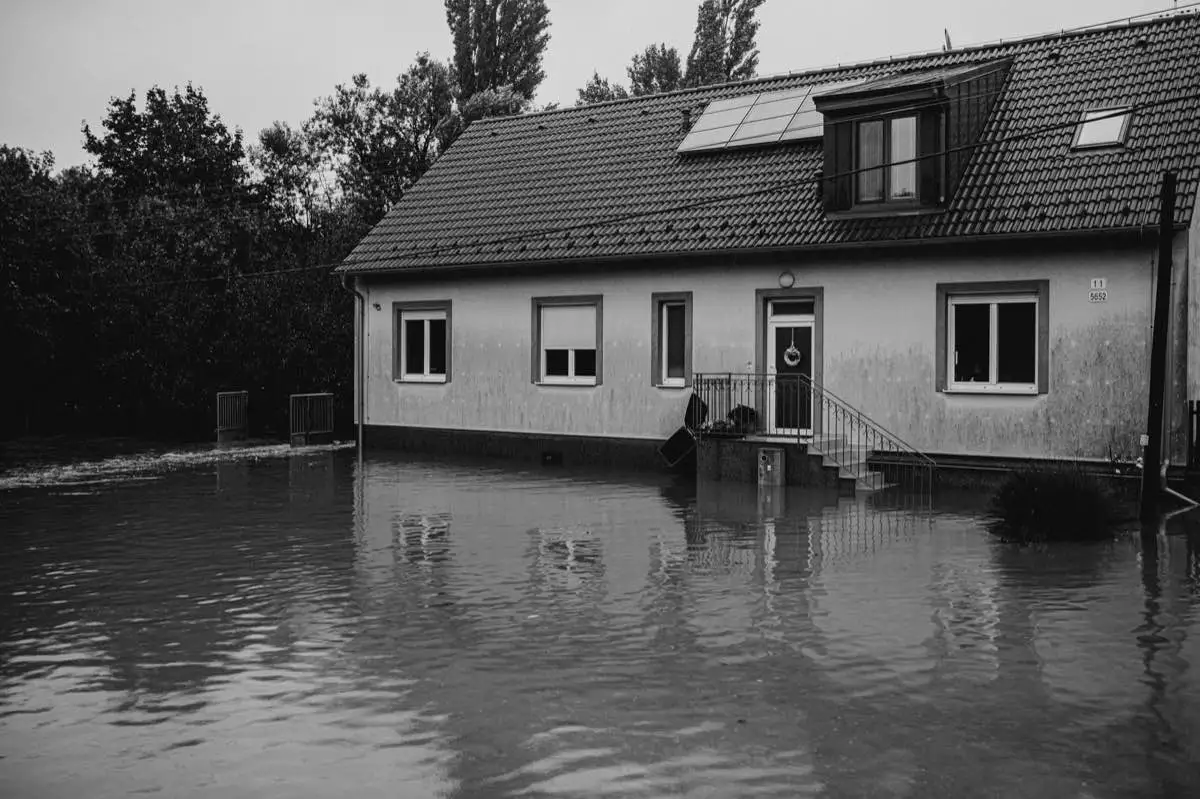
The emergency water extraction process runs in a fixed order: check for hazards, confirm the source is stopped, physically remove the standing water, set drying equipment, monitor against a dry standard every day, and document all of it. Skip a step and you pay for it later, usually in a wall you have to open twice.
Extraction is the least glamorous part of a water loss and by far the best value in it. Every gallon lifted out with a pump is a gallon nobody has to coax out of the air one drop at a time through a dehumidifier. Yes, you can rent a shop vac. No, a shop vac has never once dried a wall cavity.
Step 1: hazards before water
Nothing gets touched until the risks are cleared. Electricity in or near standing water, a ceiling sagging under the weight of what it is holding, contaminated water, gas appliances that were submerged, and structural concerns all come first.
If you are the one waiting for a crew: kill power to the affected area at the panel only if you can reach it safely and dry. If the panel sits in the wet zone, or you would have to stand in water to get to it, leave it and call the utility or a licensed electrician. Stay out from under any bulging ceiling as well.
Step 2: confirm the source is stopped
Extracting while water is still arriving is a way to spend money without changing the outcome. The main shutoff, the appliance valve, the water heater inlet — one of them gets closed before the wand comes off the truck.
If the failure is a split pipe or a failed fitting, burst pipe repair is the actual fix, and it happens before or alongside extraction. If the water is coming from outside during a storm, extraction may need to wait until the source stops, which is frustrating and unavoidable.
Step 3: classify what you are dealing with
Before equipment gets set, a technician establishes two things from the IICRC S500 standard, and both belong on your paperwork.
Category is how contaminated the water is — clean, gray or black — which decides what can be dried and what has to be removed. Class is how much material is wet and how hard it will be to dry, from Class 1 with minimal absorption up to Class 4 with water bound into hardwood, plaster or concrete. Category and class together drive the equipment count and the schedule. The full breakdown of both lives in the categories of water damage.
Moisture mapping happens here too: a penetrating or pinless meter takes a dry standard from an unaffected area of each material, then readings work outward from the wet zone until they return to that baseline. That map is the scope. A thermal imaging camera speeds up the search, though it reads temperature difference rather than moisture, so every finding it produces gets confirmed with an actual meter.
Step 4: physical extraction
This is where the volume goes away, fast.
| Equipment | What it does | When it comes out |
|---|---|---|
| Submersible pump | Moves standing water at depth | More than a couple of inches on the floor |
| Truck-mounted extractor | High vacuum with the waste going to an onboard tank | Most Corona residential losses with truck access |
| Portable extractor | Same principle, carried in | Upper floors, condos, long carries |
| Weighted extraction head | Compresses carpet and pad while pulling, recovering far more than a bare wand | Any soaked carpet you intend to save |
| Wet vacuum with a hard-surface tool | Detail work on tile, sealed concrete, stair nosings | Everywhere, at the end |
| Squeegee and wand | The unglamorous last few gallons | Always |
The rule of thumb the trade lives by: extraction removes water hundreds of times faster than evaporation does. An hour with a weighted head can be the difference between three drying days and six.
Step 5: set the drying system
Extraction gets the free water. Drying gets the bound water, and it is a deliberate exercise in creating a vapor pressure difference rather than just moving air around.
- Air movers, rated in CFM, placed at a shallow 5 to 15 degree angle to the surface roughly every 10 to 16 linear feet of affected wall, so the saturated boundary layer keeps getting stripped away.
- LGR dehumidifiers, which keep condensing water down to around 40 grains per pound, where a conventional refrigerant unit stalls out. In cold conditions or with deeply bound water, a desiccant unit does the work instead.
- Wall cavity drying using an injectidry-style manifold through small holes behind the baseline, which is often what keeps drywall on the wall rather than in a skip.
- Air filtration devices with true HEPA media, 99.97 percent efficient at 0.3 microns, on any job where contamination or microbial growth is in play.
- Containment with 6-mil poly and negative pressure at roughly four air changes per hour for Category 3 work, per the relevant IICRC standards.
Equipment typically stays in a Corona home 3 to 5 days. That is not a stalling tactic, it is how long bound water takes to leave gypsum and framing.
Step 6: monitor, and prove it
This is the step that separates a real restoration company from a van with fans in it. Every day, somebody comes back and records material moisture readings, room temperature, relative humidity and grains per pound, then adjusts equipment based on what the numbers say.
The job ends when readings on affected materials match the dry standard from the same material in an unaffected area — not when the carpet feels dry, and not when the calendar says five days. Ask for the daily log. If it does not exist, the drying was not verified, and unverified drying is how secondary water damage gets built into a house.
About the 24/7 part
Water losses happen at inconvenient hours, so this trade answers the phone at 3am and Corona Water Restoration Pros is no different. What we will not do is quote you a guaranteed arrival window over the phone before knowing where crews and equipment currently are, because that number would be invented, and you would plan around it.
What you do get on that first call is somebody talking you through the main shutoff, the electrical hazard rules, and what to photograph before anything moves. That part is free and it is worth more than most people expect.
When you should skip the call entirely
Straight talk. A clean-water spill under about 10 square feet, on tile or a sealed floor, caught within a couple of hours, that never reached carpet pad or drywall, does not need a crew. Towel it, run a fan, then check it at 24 hours with a $30 moisture meter against a dry patch of the same material. Matching numbers mean you are finished.
The same goes for a slow drip under a sink you can see and reach. That is a plumber and a wrench, not an emergency extraction. And if the whole loss looks likely to come in under your deductible, filing a claim on it will probably cost you more than it returns.
Call a crew when the water reached porous material, when it sat more than a day, when it was gray or black water, or when your own readings are flat after a full day of fans. Storm and ground water in particular is flood damage cleanup territory, and it is contaminated from the first minute.
The bottom line
Hazards, source, classification, extraction, drying, monitoring, documentation. In that order, every time. The extraction phase is short and cheap relative to what it saves, the drying phase is what actually takes 3 to 5 days, and the monitoring is what proves any of it worked.
Corona Water Restoration Pros runs emergency water extraction and metered structural drying around the clock across Corona and the Inland Empire and north Orange County, with a daily readings log you keep. Si prefieres que te atendamos en español, también lo hacemos. Call (844) 511-2320 and you will get straight answers, including when the honest one is that a fan will do.
Ready for a free quote in Corona?
Corona Water Restoration Pros — free estimate, clear scope, no pressure. Use the form on this page or jump to the homepage quote.
Related services in Corona
Corona Water Restoration Pros money pages — go straight to the service you need.
- Emergency Water Extraction →
By the time most Corona homeowners call, the standing water is already gone. What is left sits in the carpet pad, in the bottom plate of the wall, and in the slab itself, and that hidden water is what does the damage.
- Whole-Home Flood Damage Restoration →
A whole-house loss in Corona almost never begins outdoors. It begins with a supply line that lets go at two in the morning, runs unnoticed for six or eight hours, and puts water into every room on that floor before anyone wakes up.
- Burst Pipe & Slab Leak Water Damage →
This is the call Corona makes most. A copper line under the slab develops a pinhole, or a braided supply riser at a toilet lets go, and the first evidence is a warm spot on the floor, a spinning water meter, or a bill that doubled for no obvious reason.
- Structural Drying & Sub-Slab Dehumidification →
Drying is arithmetic, not atmosphere. A wet slab holds a measurable quantity of water, the air will only carry so much of it away, and dehumidifier capacity has to beat the evaporation rate or the moisture simply relocates to another part of the house.
- Storm & Wind-Driven Rain Damage →
Corona does not get hurricanes. It gets four or five serious atmospheric river days a winter, and the damage those days cause is a building envelope problem: water pushed sideways into openings that shed rain perfectly well when it falls straight down.
Frequently asked questions
What is the emergency water extraction process?
A safety and hazard check first, then confirming the source is stopped, then physical removal of standing water with pumps and extractors, then setting air movers and dehumidifiers, then daily monitoring against a dry standard, and documentation throughout. The order matters. Extraction before the source is stopped is just expensive mopping.
Why not just use a shop vac?
A shop vac will lift standing water off a hard floor, and for a small clean spill that is genuinely enough. What it cannot do is pull water out of carpet pad or a wall cavity, which is where the water that causes problems actually sits. Professional extractors use far more vacuum and weighted heads designed to compress and recover from the pad.
How long does water extraction take?
Extraction itself is usually the shortest phase, often a few hours for a residential loss, because it is physical removal rather than evaporation. Drying is the long part, commonly 3 to 5 days with equipment running continuously. Class 4 losses with bound water in hardwood or concrete take longer.
Is emergency water extraction available at night?
Yes, this trade runs around the clock because water does not keep business hours. Somebody answers the phone at 3am and can start walking you through shutting off the main and staying safe before anybody arrives. What nobody honest will do is promise you a specific arrival time before knowing where the truck is.
How do technicians know when the drying is finished?
They compare moisture readings on affected material against a dry standard taken from the same material in an unaffected part of the building, and they log those readings daily along with room temperature and humidity. The job is finished when the numbers match, not when the surface feels dry. Ask to see the log.
What does emergency water extraction cost?
Mitigation for a typical residential loss commonly runs $1,200 to $5,500, covering extraction plus roughly 3 to 5 days of equipment and monitoring. Category 3 water and large losses run well beyond that because material has to be removed and disposed of. Reconstruction is a separate cost from mitigation.
Local context
How this applies in Corona, CA
Every article here is written from water damage work done in Corona and the Inland Empire and north Orange County, so the numbers reflect local labour, permit and material costs rather than a national average. Your own job can land either side of them depending on access, the condition of what is already there, and the materials you pick — ground microphone acoustic leak location, tracer gas leak detection, post-tension tendon scanning.
The way to turn any of this into a real answer is to have someone look at your actual situation. The free estimate is free, itemized and written down, with no deposit and no obligation. Call (844) 511-2320 or start on the Corona Water Restoration Pros homepage.
Areas Corona Water Restoration Pros covers
Corona first, then the surrounding communities of the Inland Empire and north Orange County. Each has its own page with local detail rather than a copy of this one:
- Norco, CA — Riverside County, incorporated in 1964, population 26,453 at the 2020 census
- Eastvale, CA — Riverside County, incorporated in 2010, population 69,757 at the 2020 census
- Jurupa Valley, CA — Riverside County, incorporated in 2011, population 105,053 at the 2020 census
- Riverside, CA — Riverside County, incorporated in 1883, population 314,998 at the 2020 census
- Chino Hills, CA — San Bernardino County, incorporated in 1991, population 78,411 at the 2020 census
- Chino, CA — San Bernardino County, incorporated in 1910, population 91,403 at the 2020 census
Or jump to the full list of Corona services.
More from the Corona Water Restoration Pros blog
- Ceiling Water Damage in Corona: Stains and Sagging
A growing or sagging ceiling stain is active and a collapse risk. How to find the source, when to stay clear, and what to fix in a Corona, CA home.
- Categories of Water Damage Explained (Corona)
Category 1 is clean, 2 is gray, 3 is black. What each one means under IICRC S500, how fast they degrade, and what it changes in Corona, CA.
- How Much Does Water Damage Cleanup Cost in Corona?
Water damage restoration in Corona, CA runs about $1,300 to $6,300 for most homes. Real cost ranges by water type and room, plus what insurance pays.
The Corona Water Restoration Pros Team
Licensed water damage pros in Corona, CA
Written by the Corona Water Restoration Pros team — licensed, insured water damage pros with 15+ years serving Corona, CA and the surrounding area.